
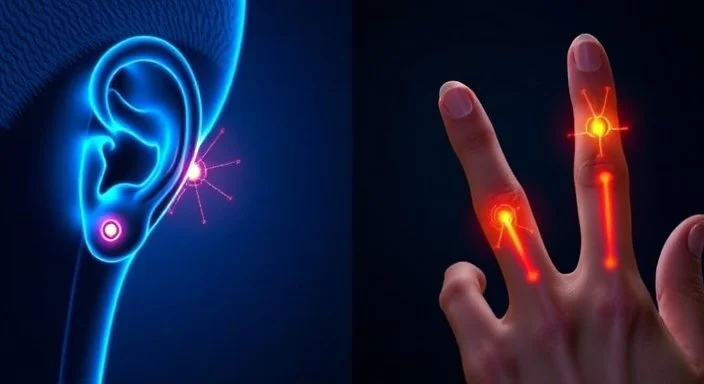
Diabetic Peripheral Neuropathy (DPN) is a common and debilitating complication of type 2 diabetes. Auricular non-invasive electrical stimulation, when applied at precise locations and frequencies, offers a promising adjunctive strategy for alleviating DPN-related pain.
Among the mechanoreceptors affected by diabetes, Pacinian corpuscles—low-threshold, fast-adapting sensors—are among the first to deteriorate in distal regions. These corpuscles play a pivotal role in pain modulation, accounting for approximately 90% of gate control pain relief, as demonstrated by Hollins et al. (2017). Notably, mechanoreceptors are also present in the external ear canal, where they support reflexive responses such as glandular secretion and muscular contraction to expel foreign objects.
Indirect electrical stimulation of these mechanoreceptors generates sensory input that not only modulates nociceptive signals at the spinal cord level but also engages cranial nerves, including the vagus nerve. This engagement activates the inflammatory reflex, which suppresses the release of pro-inflammatory cytokines and other inflammatory markers. In parallel, stimulation triggers descending inhibitory pathways from the brainstem, amplifying pain relief and contributing to systemic anti-inflammatory effects. This expanded interpretation of gate control theory integrates both spinal and supraspinal mechanisms, highlighting the multifaceted benefits of auricular stimulation.
Despite growing interest in auricular stimulation, most commercial devices fall short—limited by suboptimal electrode placement, closely spaced single cathode-anode pairs, and low-frequency output (typically in the tens of Hz). These constraints fail to adequately provide long-term therapeutic effects.
In contrast, our multi-cathode/anode stimulation paradigm, powered by proprietary Duplet Cathodes Therapy (DCT™), delivers targeted, multi-frequency stimulation with optimized duty cycles. The EvokedRx™ approach minimizes cutaneous sensation while selectively recruiting the appropriate sensory fibers and mechanoreceptors. This ensures continuous, effective stimulation that addresses both pain and inflammation. As a non-addictive, non-pharmacological modality, EvokedRx™ offers a powerful adjunct for managing DPN and broader diabetes-related complications.
Reference: Hollins M, Corsi C, Sloan P. Pacinian signals determine the direction and magnitude of the effect of vibration on pain. Perception. 2017; 46(8):987–99. doi: 10.1177/0301006617694630